


William James wrote:
Most people live – whether physically, intellectually or morally – in a very restricted circle of their potential being. We all have reservoirs of life to draw upon of which we do not dream.
Where are these gods and goddesses? What plugs the well of innate genius? I think the answer is obvious: Think of times when you’ve been deep in flow, and there is only the dance, or the coding project, or the piece you’re writing – times when you’ve surprised yourself with the quality of your output, when it felt like it didn’t even come from “you.”
It didn’t!
These are moments when the self gets out of the way. It’s what the mystics speak of, but usually when talking about a path that goes through meditation or prayer. But I don’t see any reason that unblocking genius shouldn’t also be a mystical path.
The theory goes like this:
• Our constant craving & clinging takes up an enormous amount of RAM. Think about how many mental cycles are spent clinging to status, self-image, stimulation, rejection-avoidance, unresolved personal loops, meaning, etc.
• If you lower petty clinging while *increasing* healthy desire, then the mind will naturally act virtuosically in the world. Why? Much more free compute.
• This path should be much more palatable to the ego. It will be drawn in by the genuine promise of achievement. And so the ego is drawn to create the conditions for its own surrender – which is necessary for the products of genius.
But again, the key here is to do both the standard spiritual thing (releasing craving & clinging) while *increasing* desire.
This is not egoic desire; it is desire without attachment to outcome.
I was once part of a research institute that was trying to create geniuses capable of improving the world at the greatest scales. I’ll write about this strange episode of my life soon; it was also the one full of rationalists who were also studying telepathy that I mentioned here. This institute did not quite succeed. I suspect that this was partially because its culture was absolutely obsessed with outcome – namely, the outcome of “saving the world.” This kind of high-stakes attachment dominated the psyche of everyone involved, including me. As you can imagine, this was very stressful.
The stress of attachment to outcome runs counter to genius. You may point to geniuses throughout history who were nonetheless obsessed with outcome, even ruined or driven to madness by it. However, I am very willing to bet that while they were in the flow that produced their best work, this attachment receded, and there was only the work, shaping itself into being. This is propelled by a type of desire that flows with the world rather than straining forcefully against it. The mystical path of genius is about expanding this type of desire to more and more of life until it is the air you breathe.
The Buddhist term for wholesome desire is chanda. Chanda is desire that arises from a place of non-tension. It often feels like a relaxed current, but can sometime be strong, channeled, like a great benevolent wave surging outward – and yet it is unattached to outcome. Intensify this style of desire while releasing craving & clinging, and genius springs naturally.
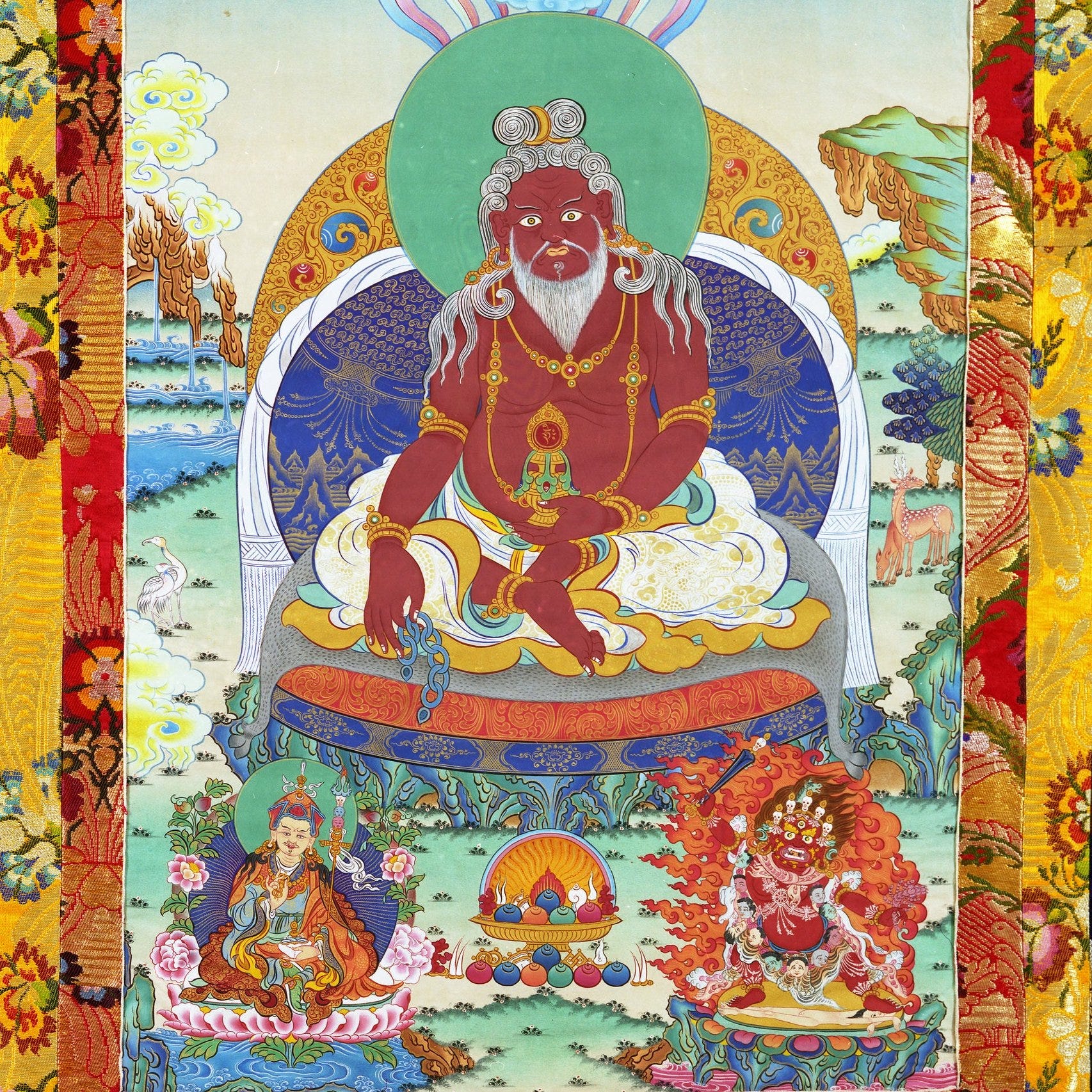
I’d predict that if this path were cultivated and disseminated, you’d end up with way more renaissance people like Thangtong Gyalpo, one of Tibet’s “mad yogis” who built 50 bridges, founded Tibetan opera, practiced medicine, designed temples across three countries, and invented new metallurgical techniques.
It is a serious thing to live in a society of possible gods and goddesses, to remember that the dullest, most uninteresting person you talk to may one day be a creature which, if you saw it now, you would be strongly tempted to worship...
—C.S. Lewis
I have a desire – I have yet not looked into whether it is chanda or whether it is craving – to live in a society not of possible gods and goddesses, but actual ones. I have a desire for your genius to spring.
Another translation of "chanda" is "interest". For example, you develop interest in the practice, and that gives you energy to pursue it. The way you frame it as process-based instead of outcome-based desire is interesting.
I think there's definitely something to what you're saying, as I've noticed that the key sign that something is going sideways in art is if there's even the slightest whiff of self-satisfaction from the artist. Anytime there's a sense of trying or effort, whatever I'm reading/seeing loses it for me. The masters just completely got out of their own way. When I make my own work, I can see the process happening in real time, and I've been realizing that the best way to develop my craft is to try to avoid those moments.
This is so resonant- thanks for sharing 🙏.
Been exploring Chanda/tanha a bunch recently against the backdrop of living into my own genius. Very cool to learn more context and to see the connection to the Gita outcome-independence mindset.