


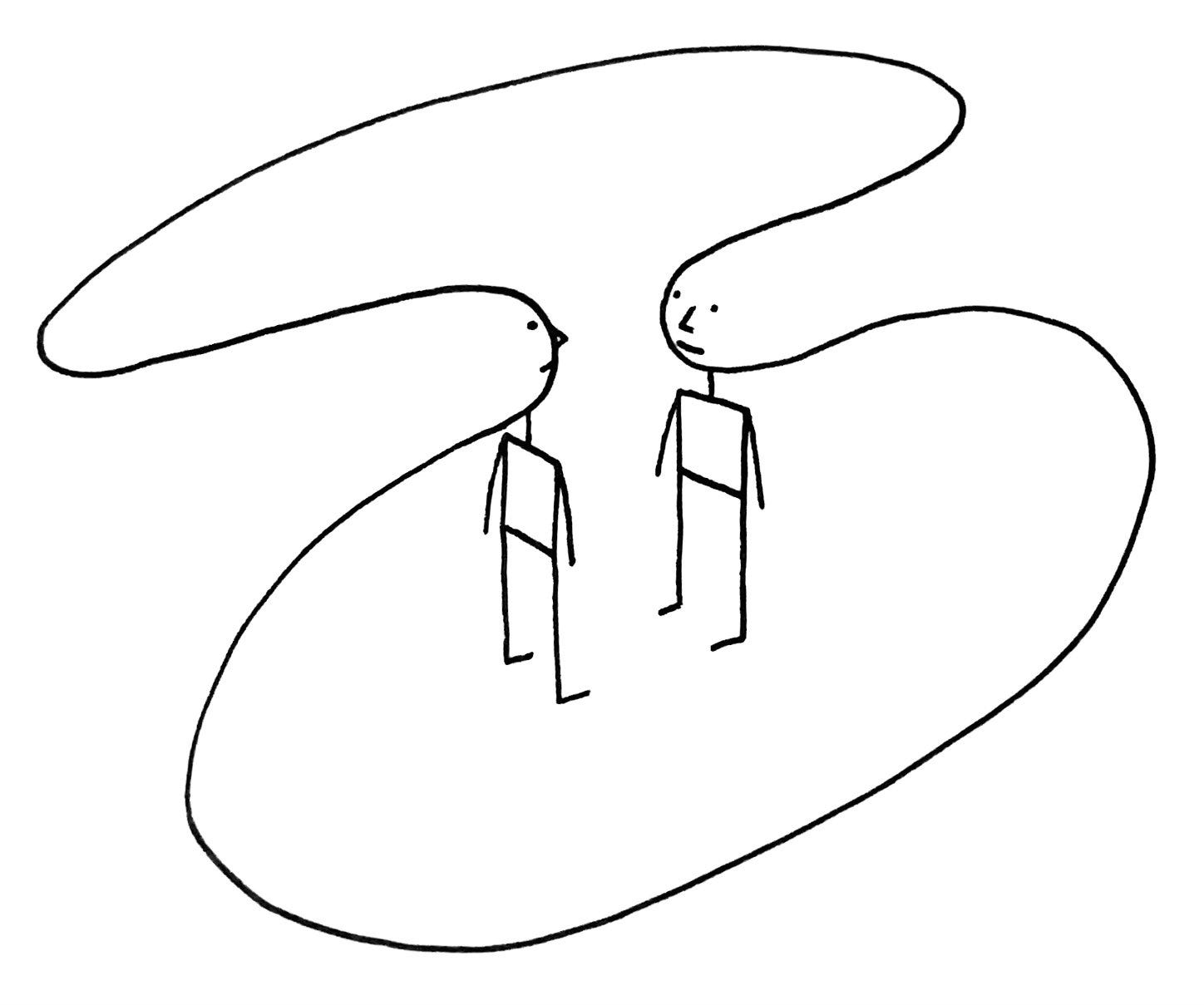
In my life, I’ve gone from being a telepathy skeptic to believing that *something* weird is going on. I can’t say exactly what that something is, but whatever it is, it hasn’t been acknowledged by mainstream academic science.
Despite my shift, I’ve become angry at both skeptics AND the new wave of believers who have flooded in through the recently viral podcast, The Telepathy Tapes. I’ll start with my own run-ins with apparent telepathy.
My experiences with telepathy
Before ~1600, most worldviews assumed that the mind was porous rather than private. Thoughts, intentions, and emotions could enter and exit the confines of an individual’s particular skull.
More recently, I was surprised to read the following statement from the father of computer science Alan Turing:
Unfortunately the statistical evidence, at least for telepathy, is overwhelming.
—Alan Turing
That bit is from his famous 1950 text on the Turing Test – one of the most highly-regarded essays in my rationality-inclined intellectual circles.
“The evidence is overwhelming?” I thought upon reading it. “If this evidence is ‘overwhelming’ then how come I’ve never heard about it?” More, I was confused why no one ever mentioned this shocking excerpt until I read it myself. I started to feel that some funny business might be going on with denial of evidence for telepathy. (More on this later.)
As for me, I was one of the deniers. Like many educated people growing up after the Enlightenment, I poo-poo’d telepathy and all related phenomena. And so, when I did eventually encounter evidence of “telepathy,” it was hard for me to accept.
I spent much of undergrad in mainstream academic science. I worked in 5 cog sci & neuroscience labs across Yale, Baruch, The New School, and UChicago. I was quite invested in my identity as a materialist and an atheist and an empiricist. But it was that last part of my identity that did me in: When an empiricist witnesses a repeatedly demonstrated effect, he must conclude that *something* is going on – even if that *something* is yet unacknowledged by the academic establishment. In fact, this is typically how science progresses through paradigm shifts.
In 2016, I experienced my own internal paradigm shift. I started encountering my first practitioners in so-called “energy healing” and bodywork. I experienced telepathy-like effects that I still can’t explain. I even learned how to produce them in others in ways that shock and amaze.
But these were specific types of telepathy-esque effects that weren’t anything like guessing the word in someone’s head. It was far more vague: the ability to produce shared phenomenology by inclining my body and mind in certain ways. On the receiving end, it can feel like taking a drug, except often much more subtle and complex. Also, sometimes there might be approximately shared mental imagery. The people who I know who are *really* good at this sort of thing can make even a skeptic shake or cry from across a room, often combined with moving their hands around in a wizard-like way.
I still cannot say with confidence whether these effects are some sort of ultra-sophisticated form of placebo, or whether they’re mediated through subtle sensory cues, or whether “actual telepathy” is happening. I can’t even confidently attest to the therapeutic value of these effects that are touted by practitioners. The people “receiving” the practice often report extremely positive and awe-inducing experiences. But it seems like the effects fade fairly swiftly in most cases.
What I can say, with the utmost confidence, is that invisible, understudied worlds of nonverbal communication exist. They are vast and they have changed my life forever. They’ve become the theme of the novel I’m writing, Psychofauna.
(As an aside, one funny way they’ve changed my life: If I’m at an event full of strangers, other practitioners and I can recognize one another from amongst a crowd. This often results in sharing little “psychic” moments together, followed by words like “wow.”)
Encountering this stuff, my reaction was “Holy crap! We should test this with extreme rigor! We need to figure out the mechanisms behind what’s going on!” But the practitioners & believers in telepathy-like phenomena rarely seem to be interested in scientific rigor. Typically, they’ve either:
(a) never developed the analytical part of their mind, or
(b) *over*developed and then rejected it.
Many believers are interested in the scientific method only insofar as it would let them put a metaphorical Supported By Science™ stamp on the whole thing.
And so I was excited to listen to The Telepathy Tapes since it involves actual tests to see whether telepathy is real. For those who don’t know, The Telepathy Tapes is an extremely popular podcast that briefly displaced Joe Rogan as the #1 most listened to show in the US & UK on Spotify. It claims to demonstrate evidence of telepathy in non-speaking autistic children.
The Telepathy Tapes
First let me say that the show is extraordinary from a storytelling point-of-view. Beyond making me cry multiple times, it also demonstrates MUCH greater rigor than most lay attempts to prove that telepathy is real. The variety of tests conducted and other sources of evidence is pretty impressive. But its rigor still has quite a few gaps.
For instance, as soon as you listen to episode 1, you hear a blatant contradiction. We meet an apparently telepathic child, Mia. She can allegedly see whatever her mother sees…even while blindfolded! Then there’s a fascinating test: Can Miya see the colors of differently colored popsicle sticks while still blindfolded? She passes the test. “I can see everywhere,” Mia says. This is presented with a sense of breathless amazement (which is what I felt at this moment too).
But immediately after, the podcast tests whether Mia can see what her father sees: “And she could absolutely not tell us what her dad was looking at,” says the host. Wait a minute. So...while blindfolded, Mia can only see what her mother sees…and she can see popsicle sticks...but she can’t see what her father sees? Wouldn’t this conflict with the just-presented idea that Mia can “see everywhere?” Hmm.
I started getting skeptical. Even more so after reading the the podcast omitted at least two of the tests that didn’t work.
It turns out that you can pay 10 bucks to watch some of the test footage. I did. And as a former (amateur) experimentalist, I have to say…the tests are full of confounding variables. For example, take the clips with Mia. Her mom is presented with a random number, like “898” while Mia has the blindfold on. Then Mia lifts the blindfold, and is asked to guess the number by pointing to digits on a board held aloft by her mother. You see Mia’s finger sticking out. And then the mother *moves the board around*…in a way that kinda looks like she’s suggesting the correct answer. 😬

If the filmmakers were trying to cherrypick the most convincing footage, they could have done a better job. Throughout much of the test footage, you can spot caretakers doing little things that could possibly be clueing the autistic children into the correct answer. Little nods. Going “mhm.” Staring directly at the correct answer.
And sadly, this all brings me into some doubt, especially as the claims in The Telepathy Tapes escalate fantastically as the podcast season goes on.
This clueing potential is exactly what the skeptics point out. And believe it or not, I actually wanted these skeptics to convince me that nothing special was going on. I’ve already needed to dramatically update my worldview enough times in my life and it’s exhausting. But I ran into a pretty unfortunate pattern as I read their critiques: The skeptics reveal themselves to be even less rigorous than The Telepathy Tapes that they’re critiquing.
Where does that leave us regarding the reality or non-reality of telepathy? Let’s get into the critiques first.
The telepathy skeptics
Here’s the thing: just using the language of critique does not automatically make you more rigorous than the thing you’re critiquing.
Most critical articles I’ve read about the podcast share the same format…
Step 1: Discredit the people involved in the show through ad hominem attacks (eg question their credentials).
Step 2: Discredit the show’s premise by pointing to debunking of “Facilitated Communication.”
Facilitated Communication was an attempt at helping nonspeaking autists speak. A helper supports a non-speaking person’s arm to facilitate the non-speaker’s ability to type a message. The rub: years of studies show that this often results in messages unconsciously produced by the HELPER rather than the non-speaker. Yes, you’re reading that right. It’s as weirdly Ouija board-ish as it sounds.
Most critiques of the podcast hyperfocus on the problems with Facilitated Communication. And yes, some tests in The Telepathy Tapes do involve methods similar to Facilitated Communication. Some. A bunch of them don’t! Only one skeptic I read – Jonathan Jarry M.Sc. – chooses to highlight this. Why only one? It’s almost as if the skeptics have just as much of an ideological agenda as the believers. Hmmmmm. 🤔
Back to the critique from Jonathan Jerry M.Sc. Like the other skeptics, Jerry is quick to point out that the autists could have been picking up on nonverbal clues. Again, I’ve paid my $10 to watch the same footage. I watched moments of potential clueing over and over again. I positioned my eyes inches from my laptop screen to catch when, eg, the mother of an autist might have angled her head slightly forward to suggest the correct answer. And…alas. I’ve concluded the same thing as the skeptics like Jonathan Jerry M.Sc.. There is a lot of potential clueing going on.
But then here’s where I seem to diverge from the critics: If clueing IS going on, it’s almost as extraordinary as true telepathy. Extraordinary to the point where – even if there’s no “extrasensory perception” happening – these are demonstrations that could fundamentally change our understanding of what humans are capable of.
One test (which I couldn’t find footage for) involves an autist named Akhil. Across the room, his mother secretly writes down a letter. In real-time, Akhil is able to call it out!
In another test (which I did find footage for), the mother is secretly shown a picture of a crocodile. Then Akhil is asked what his mother saw. On a tablet, unassisted by Facilitated Communication, he types out C-R-O-C-O-D-I-L-E!
The skeptics would point out the possibility that Akhil could be picking up on subtle body language clues from his mother to guess the right letter. Sure, that could be happening, but, like…that’s absolutely extraordinary???
Let’s take the second test I mentioned, where Akhil correctly types out C-R-O-C-O-D-I-L-E. And let’s take the skeptic view that he mom was somehow clueing him with – I don’t know – her eyes and other bits of subtle body language. When Akhil starts typing the message, he is facing away from his mom. So to hit the first letter “C” on his iPad, he would have needed to notice subtle body language in his peripheral vision in a way that somehow guided him to hit one out of 26 letters. Can YOU do anything like that? Probably, like me, you’ve never tried anything of the sort because it seems far-fetched. Superhuman, even.
“Maybe it was all staged to begin with.”
Maybe. I doubt it. I actually think the podcast hosts were making an honest attempt as non-scientists. But let’s say that it was all faked.
Presumably, the 30 years of studies “debunking” Facilitated Communication were *not* faked. And remember, they showed that helpers *transmitted words through touch alone*…without realizing it. Apparently, the helpers were guiding the autists’ arms through movements so subtle that no one realized that this was happening, including outside observers and the helpers themselves. These micromovements somehow led the autists to form words from *the helpers’ unconscious*. (i.e., the helpers didn’t realize the words produced through Facilitated Communication are actually coming from them).
Think for a moment about how nuts that is. Did YOU know that you can get another person to write out secret messages from your unconscious through touch and imperceptible movements? This effect has its own scientific term – one that sounds much more boring than the actual phenomenon: the ideomotor effect. Why is this not a bigger deal?!
As I alluded above, I also have learned to nonverbally “transmit” stuff, sometimes at a distance, sometimes through touch. But these are transmissions of things like vibey states and – at best – vague mental imagery. And sometimes it doesn’t work. If you’d told me that you met someone who is able to transmit discrete information like *entire paragraphs of text* through touch, I’m not sure I would have believed you. It sounds sci-fi, like the skills that Bene Gesserit sisters wield in Dune. And yet we have 30 years of research demonstrating that this is possible. Even the skeptics are believers in this crazy phenomenon.
Even in the skeptic view, humans would have sensitivities far beyond the mainstream imagination. So what if these sensitivities have a materialist explanation? It doesn’t make them less wondrous to me. In fact, I’d still be very tempted to call these sensitivities something like “practical telepathy.”
But the skeptics don’t seem very interested in the unmapped wonders of subtle perception. I only found one journalist, Elizabeth Weil, that went as far as visiting a couple of the autistic children to see the phenomenon for herself. Results were mixed: she mentions one hit, one miss, and one ambiguous result. Other than Weil, critics seem more invested in tearing down The Telepathy Tapes than in investigating the truth of whatever weird thing is going on.
It’s understandable what the telepathy *believers* have at stake: If telepathy is real, well…that has world-changing potential. It makes sense that they want to believe, even at the expense of rigor.
But how do we account for the lack of rigor of the skeptics? In their articles, they downplay or even mock the wonder of these phenomena while explaining them away. They cherry-pick only the most questionable tests from the podcast. It feels like skeptics have an equally religious position of disbelief. What do they have to gain from this?
Surely we can do better. Surely we can find ways to open our minds without our brains falling out.
The dangers of telepathy
Back to the question: What do skeptics have to gain from a dogmatic position of disbelief? I actually have a bit of a crackpot theory here, if you’ll allow it.
A strange possibility I will suggest: The skeptics are performing a cultural immune system function. That is, maybe (unwittingly) they are carrying out a collective adaptation that actually keeps our society healthy. As an analogy, think about the people who enforce table manners. They probably wouldn’t be able to tell you *why* table manners are adaptive. But there are plenty of reasons why they might be – e.g. hygiene, lowering disgust triggers, signaling respect, ceremonializing eating together as a meaningful act, etc.
I wonder whether disbelief in telepathy, and the downplaying of subtle perception in general, is an adaptive function that people today collectively reinforce.
In the old world, telepathic phenomena were a given. But the old world wasn’t always a pretty one. Another person could inject their bad intentions into you by giving you the evil eye. An unwanted suitor could inflame you with desire through love magic. Your mind could get invaded by a ghost or a demon.
Indeed, even today, the hypersensitive “practitioners” I mentioned above are always getting messed up by the vibes of others. Sometimes they get messed up to the point of physical illness. Likewise, I have known – and have been part of – groups that go collectively insane from messing around with telepathy-like effects. One of them was a research institute full of people who prided themselves on rational thinking skills. I plan to write about these wild experiences soon.
But for now, in brief: Hypersensitivity to one another resulted in the explosion of tensions that are normally brushed under the rug in our conflict-averse culture. Also: since the epistemology of “who’s bringing the vibe” is inherently tricky, people started projecting onto one another like mad. Here’s a representative caricature:
Person A: Can you please stop broadcasting that bad intention?
Person B: You’re the one who’s projecting the bad intention.
Person A: You’re an evil wizard.
Person B: No, you are!
Madness.
Whatever is going on with this stuff, it can clearly spiral out of control. And so it may actually be a human universal that cultures develop protections against telepathic and “supernatural” phenomena.
The Border Crossing
Imagine there’s a place called the Border Crossing. All sorts of powerful things come through from beyond the border to invade our minds: angels, demons, curses, blessings. Different cultures have different ways of dealing with what crosses the border.

Christianity’s strategy is traditionally to put a security force at the Border Crossing – one typically run by the church. This security force only lets through things that are aligned with Christ. Faeries? Denied. Healing powers? Either denied or you’ll need a permit. Wiccan love spells? Not only denied, but if you smuggle those in, we will detain you (or burn you alive).
This border police strategy signaled a break from the more historically common shamanic, pagan, and animist strategies. In these cultures, there doesn’t seem to even be the idea that you *can* police the Border Crossing. The things that come through are simply part of nature. In some cultures, the concept of a border between the human and supernatural world might not apply at all.
If the border is wide open, you need to develop more customized tactics for dealing with the things that come through. Nightmares? Use a dream catcher because they could have been sent by an evil sorcerer. Trickster spirit? Cut a deal: let the spirit possess your mind but only within the safe confines of a religious ritual. Curse from your enemy? Wear a warding amulet.
In fact, even in Christian cultures, warding symbols were common up until fairly recently: horseshoes over doors, salt across thresholds, rowan branches. Across most cities you can still see these things – the lions, gargoyles, and grotesques carved into old buildings to ward off evil. These things were simply pragmatic, like how today it’s pragmatic to put your phone on silent to ward off the influence of constant notifications.
I find the route taken by many Buddhists cultures most interesting of all. The Border Crossing is left (mostly) unpoliced. Instead, practitioners are encouraged to simply not engage the things that come through. In fact, the earlier traditions advocate active disinterest. Telepathic powers? Lame. Most branches of Buddhism take it as a given that practitioners can develop telepathic abilities. But these traditions also warn that telepathy is typically a huge distraction from the path.
Apparently, in Zen, telepathic abilities are often derided. Telepathy might be responded to with something like “If you think you’ve read someone’s mind, try to find the one who is doing the reading.” Even Vajrayana Buddhism, the tradition most permissive of special powers (“siddhis”), warns that subtle perception can be exceptionally dangerous. Psychic abilities can inflate ego and amplify delusions faster than clarity. (I personally have perceived this to be the default in those who choose to develop them.)
Straight from the mouth of the Buddha – at least according to the Kevatta Sutta:
“And what is the miracle of telepathy? There is the case where a monk reads the minds, the mental events, the thoughts, the ponderings of other beings, other individuals, [saying,] ‘Such is your thinking, here is where your thinking is, thus is your mind.’…I feel horrified, humiliated, and disgusted with the miracle of telepathy.”
Damn, Buddha.
So that’s on entering the minds of others. What about when another mind – human or otherwise – tries to enter *yours*? A standard Buddhist answer is that you detach from the target: you disidentify from the illusory self that negative influences get their hooks into.

Now we come to the answer from our culture. The answer from modern Western culture breaks from tradition in a way that’s historically unprecedented – a genuinely novel experiment.
Some might say our answer has been this: Close down the Border Crossing entirely; build a giant wall there; keep ‘em out!
But actually, we’ve done something even more radical than that. We have denied the existence of the Border Crossing altogether. There is no weirding realm – says our worldview – there is only this material one. Nightmares? Random firings in the brain, or maybe psychological trauma. Trickster spirit? That’s just called “some guy being an asshole.” But if he really think’s he’s possessed, well here’s the entrance to the psych ward. Curse from your enemy? I don’t believe in that stuff. Telepathy? Fake!
What I’m theorizing here is that perhaps disbelief is a form of protection. Perhaps doubt in telepathy not only proves that we are Reasonable Modern People, but also shields us against its worst effects. If so, maybe we should be thanking the telepathy-skeptics despite their dishonest attacks on believers. Maybe. That will depend on whether this strategy of denial constitutes a protective breakthrough or a massive vulnerability. My guess is that it’s a bit of both.
Either way…I hope that instead we can move to more sophisticated protections rather than denying and deflating empirical evidence.
The future of telepathy
As for me, I’m still agnostic on the reality of “true telepathy” – i.e. transmission of mental information without use of the known senses. There’s almost certainly *something* interesting going on. But maybe it really is all just hypersubtle clueing and placebo. I’d still find that extraordinarily exciting!
Alternatively, many animals use the magnetite in their bodies for magnetoreception. Did you know that humans have magnetite in our brains? More, did you know that some recent evidence might demonstrate that humans have a magnetic sense?
Totally shooting from the hip here, but maybe we’re able to pick up on the weak electromagnetic fields emitted by other brains and bodies. Hammerhead sharks use electroreception to sense the bioelectric fields of their prey, including possibly their heartbeats. Caterpillars can sense the electric fields of their predators. Might we do something similar in a way that looks kind of like a telepathic sense, one that we’ve forgotten how to use? Who knows?
Not us, because science-minded types are apparently more interested in tearing apart the less-than-rigorous experiments of The Telepathy Tapes than promoting more rigorous ones. In many scientific circles, you’ll get ridiculed for even proposing a contribution to the pile of evidence for telepathy that Turing considered “overwhelming.”
“But maybe that’s for the best,” you might note, “Didn’t you just say that telepathy is dangerous and drives people crazy?”
Yes, I did just say that. Fire is also dangerous; it burns down houses. But once we learned how fire worked, we were able to harness it for the benefit of humankind – for instance, to cook food. We can learn how apparent “telepathy” works and do the same.
In fact, we don’t even need to start from scratch. Mystical traditions preserve 1000s of years of know-how around how to use subtle perception in ways that are more safe and beneficial. If science-minded types can find a way not to scorn their knowledge as mere superstition, maybe a thing or two can be learned. Just maybe.
Drawing from these traditions, here’s a funny guide I wrote that might be of benefit should one delve into the waters of subtle perception (read in particular the “Bonus Section”).
Of course, you could ignore all the precautions. You try to use “telepathy” to gain power. You could use it to non-consensually sense into the secrets of others. (The host of The Telepathy Tapes has claimed that the CIA infiltrated their group.) You could use it to prove to yourself that you’re an amazing shaman or whatever. But then don’t complain to me when you accidentally go insane or develop a mysterious chronic health condition! (Such things are *not* rare for those use who this stuff for unwholesome means.) For the rest, I would advise that if you meet anyone who messes around with subtle perception and has even an inkling of an off-vibe, you politely move away.
Despite Buddhism’s explicit warnings against telepathic abilities, a Buddhist nun once taught some of these abilities to a group I was with on retreat. First, she sat us all in a circle. Then she had some people go in the center of the circle and close their eyes. Finally, she asked those around them in the circle to allow tender energy to “radiate” outward from their hearts. I can’t say whether the effects were placebo, but while I was in the middle, I definitely had an unusual and wonderful experience. Afterward, the nun said something very touching to me as she encouraged me to keep using these “powers” (as she called them). “You have a beautiful heart,” she said. “You should share your happiness with the world.”
This is how “telepathy” is best used in my opinion. You can use it to share your happiness with the world. You can also use it for some seriously profound lovemaking. You can use it to connect more deeply with others, like the autists who are able to transcend their disabilities to connect with their caretakers beyond words. You can “use” it for things that are ends-in-themselves. I’ve used it to tell nonverbal jokes, and even used it as a shared artistic medium.
I’ve put off writing about this stuff for a while. I still had my rationalist reputation to uphold. But I write about it today, because if there was ever a time for us to learn how to connect more deeply with one another, it’s now, in the midst of a loneliness crisis that spans nations. If hammerhead sharks use electroreception to sense the heartbeats of prey, what if we used our own ability to help hearts beat together?
“That’s cheesy,” you might be thinking. You’re right, hearts beat together – very cheesy line.
But have you tried it? Be a true empiricist. Run some weird experiments with someone you love. I recommend you start by suspending disbelief. Pretend that – somehow – you already know how to sync hearts telepathically. Then try some variations. See what happens. (If it stops feeling wholesome, stop!)
You could even measure your heart-rates with cheap pulse monitors. Maybe you literally can get hearts to sync up. Hell if I know – this is severely unexplored territory by modern people. But most important is how you and the other person feel together doing it.
I also recommend trying this with animals, who seem more naturally sensitive to this type of thing.
Perhaps what you’re experiencing is telepathy or maybe you’re “making it up.” (Really! It is very easy to accidentally make stuff up while exploring psychospiritual stuff – something the hippies rarely want to acknowledge.) So how will you investigate whether you’re making it up? How will you make sure you’re not deluded by your desire to believe, or your desire to disbelieve?
It’s fitting that Alan Turing, who wrote that evidence for telepathy was overwhelming, was also foundational to the building of machines that are now the primary means by which minds connect across distances. Today, these means allow us either to feel less alone or to drive each other crazy.
It’s time for us to develop maturity around connection at a distance. The conduits exist. What will you send through them? What will you receive?
Actually, the more I explore this weird medium, the less interest I have in discrete “sending” and “receiving.” The real depth, I think, is found in mutual attuning, like two violins tuning to each other before the song begins, or two tango dancers losing track of who’s leading and who’s following, or like those moments when eyes meet and it feels like an infinity mirror is formed between them:
If the doors of perception were cleansed every thing would appear to man as it is, Infinite.
—William Blake

Beyond simple stances of doubt and belief, there is a field:
Out beyond ideas of wrongdoing and rightdoing, there is a field. I’ll meet you there.
—Rumi
The field is vast and empty and there is so much to explore. Bon voyage. Perhaps I’ll meet you there.
I actually wrote a note that touched on a similar idea as your disbelief-as-protection mechanism, but geared towards demons. Demons are essentially "other selves", and the defining factor of a self (at least in Buddhism) is that it has power or control of some sort. I think that self-view ultimately means the idea that the phenomenon of self-concept has some sort of power over you. So if we posit demons are other selves, then that means they may also have some type of power over us: we're basically extending self-view outwards. But by disbelieving in demons, we engage in a quasi-Buddhist not-self practice of seeing them as "just thoughts, just feelings, not me, not a demon either". It's not exactly not-self, but it gets pretty close to the modern approach to not-self in general (which I think is a modern misunderstanding of its original meaning, but that's another story). This is also one of the reasons I am often skeptical of Christianity and its approach to demons, because I see that it tends to make people pretty obsessed with demonics, witches, etc., thereby making them buy into them more, and potentially opening them up to attack if it turns out that demons are real. Like you, I think that Buddhism has the strongest anti-"demon" defense because it completely deflates them: whether they're actually demons or intrusive thoughts, they're ultimately the same thing, which is selfless phenomena that are at best superfluous.
In the theater community, there is a group exercise called "telepathy." The goal is to count from 1 to 30 without making a mistake. The challenge lies in the fact that only one person can say each number, and if two or more people say the same number, the count starts over. There is no way to agree on the order. If you try this in a group of up to 10 people who have just met or are hearing these rules for the first time, you will be amazed at how quickly the task is completed and how it can be further complicated. You can literally watch as people's brains align and predict each other's actions. I believe that telepathy exists, but it is not like a messaging app and requires a delicate alignment. This is particularly evident in large creative teams where body practices and mental discipline are employed.