



My schooling led me to conceive of Ancient Greek polytheism as a set of superstitions that made for good literature. Lately, that has changed. I now believe polytheism is cognitive technology for relating to forces beyond our understanding and control. It’s a technology we’ve yet to inherit. This essay is about what we’re missing out on.
There are external and internal forces that shape self and world. The Greek gods represented those forces that were most salient for the Greeks at the time1, including:
Earthquakes & the sea (Poseidon)
Power & its inherent capriciousness (Zeus)
The activity of hunting (Artemis)
Romantic desire (Aphrodite)
War (Ares)
These forces were categorically diverse: Some, like Hera – goddess of marriage, family, and female gender culture – are cultural forces, things you might call egregores, or collective minds. Others, like Thanatos – god of death – are natural forces, albeit ones that often come with many cultural rituals and associations.
In order to live well, the individual and society need to come into right relationship with these forces that surge about, or else be disrupted by them.
Why divinize?
Why conceptualize these forces as ultra-powerful humans? Isn’t anthropomorphism misleading? The pre-Socratic philosopher Xenophanes famously mocked it: “If horses had gods, they’d look like horses.”

When we try to understand the forces of the world in the same way that we try to understand people, we make errant predictions. Markets, the weather, ideologies, and technologies do not conform to the logic of humankind. This is part of why such forces are constantly catching us by surprise.
So is there a benefit to anthropomorphizing forces? Yes. Generally, if we come across a flourishing society doing something that looks like superstition, we can assume that they were onto something.
That something is this: We are much more fluent in the language of agents taking actions than we are in the language of large-scale complex processes unfolding.
We can harness this fluency in agent-based thinking. We can use it similar to how we use our fluency with 3D space. Both agents and 3D space can be employed as sets of self-aware metaphors. Our spatial metaphors include phrases like “Prices are going up” or “I’m feeling low.” We say these things despite knowing that prices have no spatial dimension. A price or mood is not a physical thing that can go up or down. Nonetheless we invoke space as a cognitive strategy for understanding the abstract dynamics of prices and moods.
We do this because failing to harness our natural fluencies is leaving processing power on the table.
When we metaphorize a force as an agent, we have a much easier time tracking:
The force’s tendencies (as the agent’s preferences)
The force’s typical outcomes (as the agent’s goals)
How the force presents itself to our senses (as the agent’s personality and appearance)
We can use this fluency to our benefit as long as we understand its biases and constraints.
Here we see that the Greeks and other pagans were not fools. It would be foolish to represent a great force as an ordinary agent, like a human. That would bring in too many anthropomorphic biases. E.g., “Oh, yes: war. Very disruptive, just like Timo over there. We try to calm the fires of war the same way we calm Timo. In fact, let’s call war ‘Timo’.”
Clearly that wouldn’t work. War is far more vast and difficult to understand than your buddy Timo. So, instead, the ancient world represented forces as divinities.
Gods, spirits, and demons do share some qualities with humans. They self-preserve and they have things that look like goals and preferences. And yet they are also shrouded in divine mystery. We must practice humility when dealing with divinities in the same way we must do so when dealing with forces, since, due to our limitations, they are (partially) beyond human comprehension.
“Sacrilege!”
This essay is mostly written for those holding skepticism toward the concept of gods. But my other audience consists of those who might shout “sacrilege!” at the apparent downgrading of gods to “mere” forces.2 To these I ask: Have you ever tried to behold a great force? Not just analyze it but behold it, in its full, incomprehensible form?
Behold, for a moment, the Technic. The Technic is a force described by Italian philosopher Federico Campagna.3 It seeks to transform reality itself into something exhaustively measurable, thereby turning all things into tools. After arising several times across empires, the Technic finally fixed its steely beams into our world like an alien invader during the Industrial Revolution. From there, it extended into all aspects of human life. Humans became human resources. Nature became a stockpile of raw material. Architecture became space to optimize for the maximum amount of productive activity to happen at the lowest cost possible.
The Technic brought about the most rapid visual transformation of urban life the world has ever seen. Within one generation, you would have watched its aesthetics of efficiency take over your city:
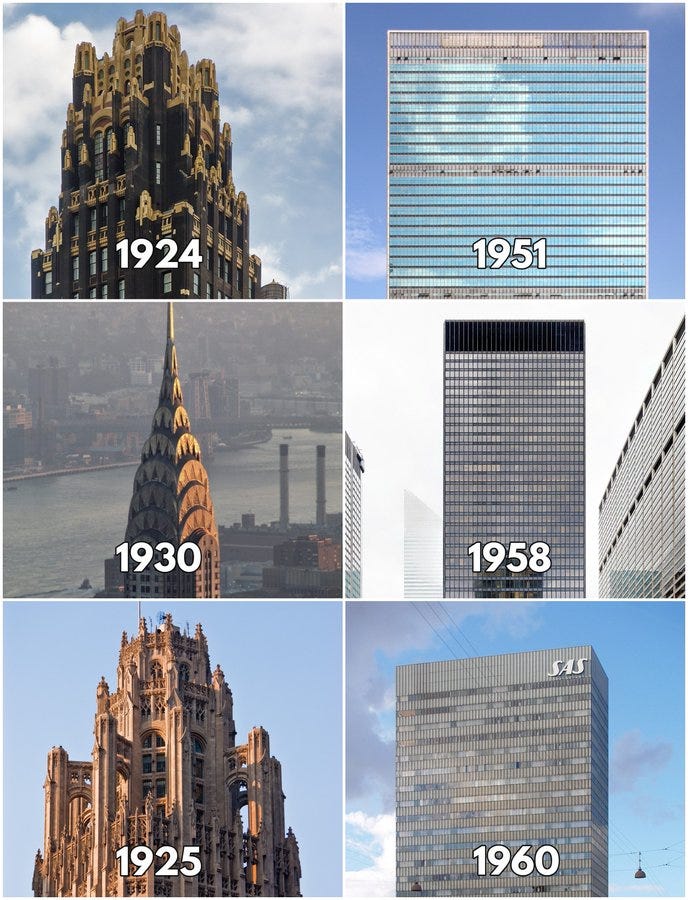
The Technic consumed the strategic intelligence of Athena, the clarity of Apollo, and the inventiveness of Hephaestus, metastasizing upon their bodies and fusing them into a single borg-like organism, threaded with wires and circuitry:

Now it makes tools of our very minds, harvesting and channeling our attention for its own ends: a perfectly predictable, fully utilized cosmos. Meanwhile, its avatars throughout the tech and corporate worlds invoke its powers like Lady Macbeth. She intone a dark prayer before she strips herself of humanity to commit deeds in the spirit of cold instrumentality. Likewise, you can hear the Technic’s avatars chanting:
Come, you spirits
That tend on useful thoughts, unsex me here,
And fill me from the crown to the toe top-full
Of efficiency! Make thin my blood
With Five Hour Energy! Grind the knife
Of my focus against a stone
Until its precision lets me blur the edges
Of my vision and cleave through spreadsheets, Analytics, APIs, Adwords, Customer relationship management systems,
And SWOT analyses which enable optimization of KPIs for
Business-to-business software-as-a-service multichannel licensing solutions promoting over 2,400 retweets per instant!
The proper response to the size and power of such a great force is the same one we have to gods: terror, vertigo, and awe. Semele, when she beheld Zeus’s full splendor, burst into flames.
There are some forces, which, once beheld, we might seek to oppose. But single-handedly opposing such a force leads to the same ruin as opposing a god, described in Greek tragedies. One cannot oppose a god. But one can call upon other gods – and in their alliance, find the counterweight that restores cosmic balance. (I will touch much more on this two posts from now – subscribe to receive it.)
Collect them all
Once we understand polytheism as a cognitive strategy, one strange feature of the ancient world begins to make sense: Cultures would collect and worship one another’s gods. In Nubia, the Kingdom of Kush adopted Egyptian gods like Amun. Egypt’s New Kingdom imported Baal and others from the Levant. And Rome, well, Rome went wild with the absorbing of gods, including Isis from Egypt, Cybele from Phrygia, and the majority of the Greek pantheon.
This might seem baffling to the minds of monotheistic cultures. Isn’t it sacrilege to worship a foreign god? Wouldn’t your own gods be pissed?
Not if you understand that gods represent forces. Entering a relationship with a new god could mean increasing your ability to work with those forces. New gods extend your power. And they extend the power of your pantheon.
Imagine you run an organization but lack a designer and a marketer. Obviously, you want to bring new types of talent onto your team. And when it comes to adding a new team member at the scale of a god, not only do you get that force as a new hire, you also win the loyalty of their adherents.
Even monotheistic religions can’t resist the benefits of this polytheistic strategy. See the many Catholic saints who preside over various forces and domains.
Which forces do you struggle to relate to? Which ones catch you blindsided? You might consider adding them to your pantheon.
Maybe you’re like me, and you’re unskillful at finding the things you are constantly losing: keys, jackets, debit cards. One option is that you could try to break down the skills needed to find lost things. Another option is to divinize these skills, turning them into a gestalt that you absorb through worship.
You could pray to Saint Anthony of Padua, for example. You could entreat the saint’s ability to locate what is lost with the old Catholic rhyme:
Tony, Tony, look around. Something’s lost and must be found.
I suspect that praying to Saint Anthony might prime your ability to enter a different mode of consciousness, one in which some part of you remembers where you left your keys.


Saint Anthony can help us find other nonphysical things. Catholics sometimes pray to Saint Anthony to recover lost faith.
Let this essay series form a prayer to Saint Anthony. Help us rediscover the wisdom of the polytheistic worldview. May this essay series find fertile ground in the minds of the curious, the minds who look around. May it help us find what has been lost and must be found.
Subscribe below to receive the next in this series: “How to relate to gods” – a guide on how to engage great forces.
I make no claims about whether Greeks themselves believed “gods are basically just metaphors for natural and cultural forces.” I only claim that polytheism nonetheless does operate as an adaptive cognitive strategy, whether or not its adherents are aware of such.
I am agnostic on whether gods exist as gods beyond forces, metaphysically speaking.
Campagna’s book, Technic and Magic, is a great resource for understanding the Technic.
Also read my friend Octopusyarn’s related series in which he analyzes evil through the frame of gods and devils.
Nietzsche says somewhere that one of the cultural benefits of polytheism is that it allows for the development of individuality. Every monotheism tends to post a single human type as universal. Worship of many gods is our first movement toward allowing the proliferation of many *kinds* of people, ideals.
One aspect of Godhood that I, especially, have always been fascinated by is its tendency to devour: the mingled horror and ecstatic joy of sacrifice, of *being* sacrificed. In this, I see a unity between Greek tragedy and the Passion of Christ.
Have you ever read Klages? Your description, or Campagna‘s, of the Technic reminds me of his *Geist*. He, too, conceives it as an invading power, though his picture encompasses both the Technic itself and the philosophical / rational turn that engendered it. And of course he hates *Geist* with a passion.
Well, "Rule Of Law" is such an entity. But then it hurts when some people aren't bound by it. So it's probably not healthy to get attached to it...but how else.