


This is part 4 of 4 of the practical polytheism series. It can be read on its own, but if you’d like, you can read part 1 here.
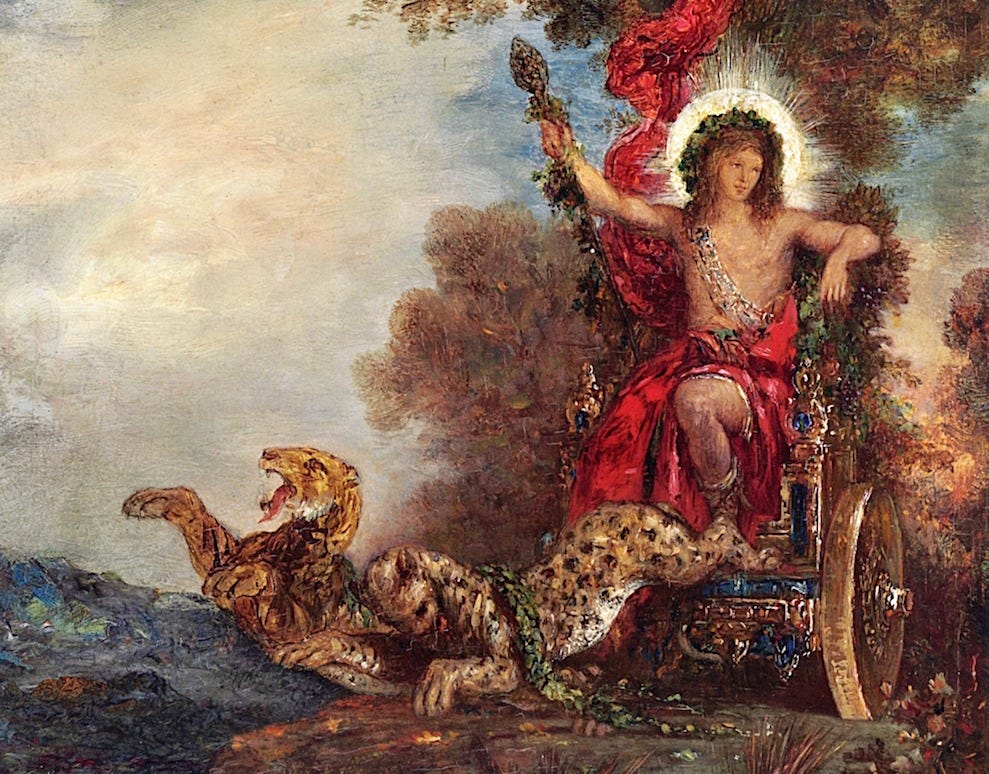
To wrap up this series, I will tell a personal story about one of my gods, Dionysus, as a case study.
We have a silly stereotype of Dionysus. We think of him as simply a party god. But the Greeks understood Dionysus to be one of their most powerful and dangerous deities. Yes, he is, of course, the god of wine and revelry. But more fundamentally he represents the dissolution of boundaries between human and divine, civilized and wild, sanity and madness, (maybe even:) life and death. He is the god of liberation.1
Dionysus taught his followers how to reach divine unity through ecstatic consciousness. He was central to the Orphic Mystery school. His initiates gained unique access to a blissful afterlife.
His cult was distinctive for its emphasis on direct experiential encounter with the divine rather than the more transactional piety typical of much Greek religion. One fact that amazes me is the degree to which Dionysian worship – which promoted a sort of divine madness – was integrated into the polis. In Athens, for example, Dionysian festivals were funded by the city and attended by rich and poor alike. I believe this had an adaptive function beyond just city-wide revelry. As I wrote elsewhere, strong cultures ritualize their own disruption. Doing so helps you prepare for the chaotic times that you didn’t plan.
Compare the present day. We live in a culture that is rapidly losing the capacity for disinhibition, free-flowing liveliness, and collective ecstasy. This comparison between the New Year’s Eve celebrations in Times Square in 2002 and 2024 is disturbing:
Dionysian activities are dropping across the board. Adults aged 18–64 having weekly sex fell from 55% (1990) to 37% (2024) in what’s being called a “sex recession.”2 Americans are also partying less and less.3 And, for better or worse, the amount of U.S. adults who drink alcohol has hit its lowest point in Gallup’s 90 years of polling.4
I remember how my first weeks moving back to NYC in 2023 were filled with a particular sort of horror. As an avid dancer, I excitedly returned to the clubs I had been recommending for years as places where people actually let loose: Mehanata, House of Yes, and others. However, when I returned, I not only saw that there was dramatically less dancing, but also that the dancing that was happening was much more listless and self-conscious than I remembered. For a Dionysian like myself, it was tragic.
Meanwhile, our only remaining utopian visions come from tech cultures and have about 0% Dionysian energy. Here is an image I often see posted on Twitter as a “perfect world” meme:

It looks incredibly tame.
What happens when the ecstatic impulse becomes repressed in a society? The Bacchae, the play by Euripides, has an answer: the bad kind of chaos. Today we see the liberative drive erupt in destructive forms – addiction, mania, political frenzy. It no longer has the role of renewing the polis.
The liberative drive is inevitable. The question is whether you can build a civilization that can channel it toward positive ends.
I don’t think we’ve reached game over. There are places across the modern world where the ecstatic impulse is still alive, and growing stronger. Below is an entry I wrote on December 12th, 2025, edited lightly.
Today I was reminded of how gods are “real” and will give you boons for your devotion.
I went to the same morning dance party I go to every Friday. Except this time I decided to dedicate my dance to Dionysus (!).
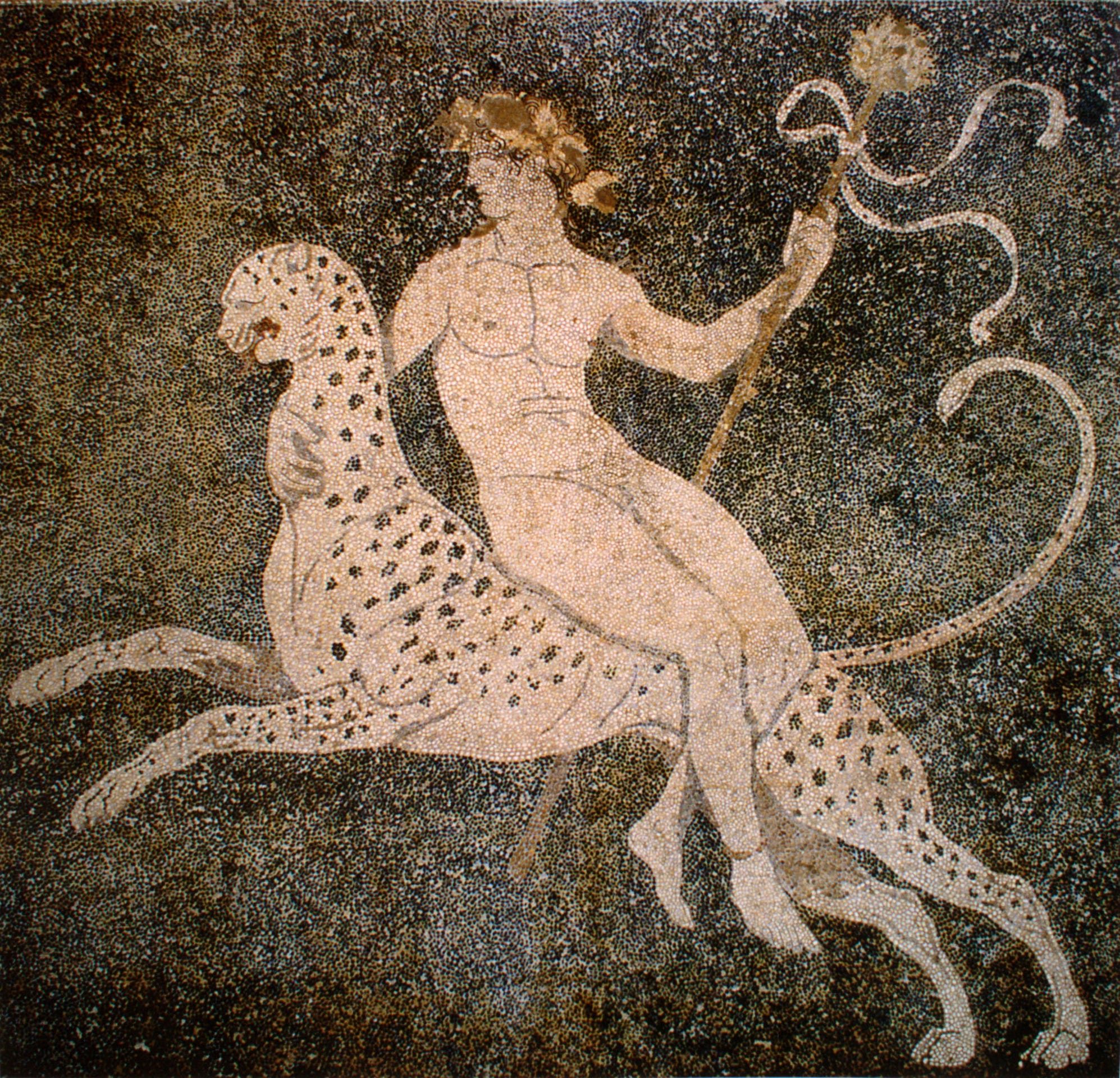
Dionysus is a god I’ve had a long affinity for. Sometimes when people are high or sufficiently drunk around me, they notice that I have a bit of a Dionysus thing going on. But I’ve never had an intentional devotional practice until recently.
The way I do it is that I ask the god, “What would please you?” They usually answer me in vibes, images, or by initiating actions. This time, it was dancing repetitively with the beat. Then it was moving with more spontaneity and chaos. Then it was synchronizing these movements with the people around me with subtle body-language invitations
Pretty soon, me and the crowd around me were in a Bacchic frenzy, ecstatically flailing and howling loudly. This sort of thing is known to happen at this morning dance party, but this was the most intense event like this I’d experienced so far.
OK, devotional act: check. Then came the boon...
As you may know, the more important members of Dionysus’s posse are arguably the maenads, “mad women” who carried out the god’s will.
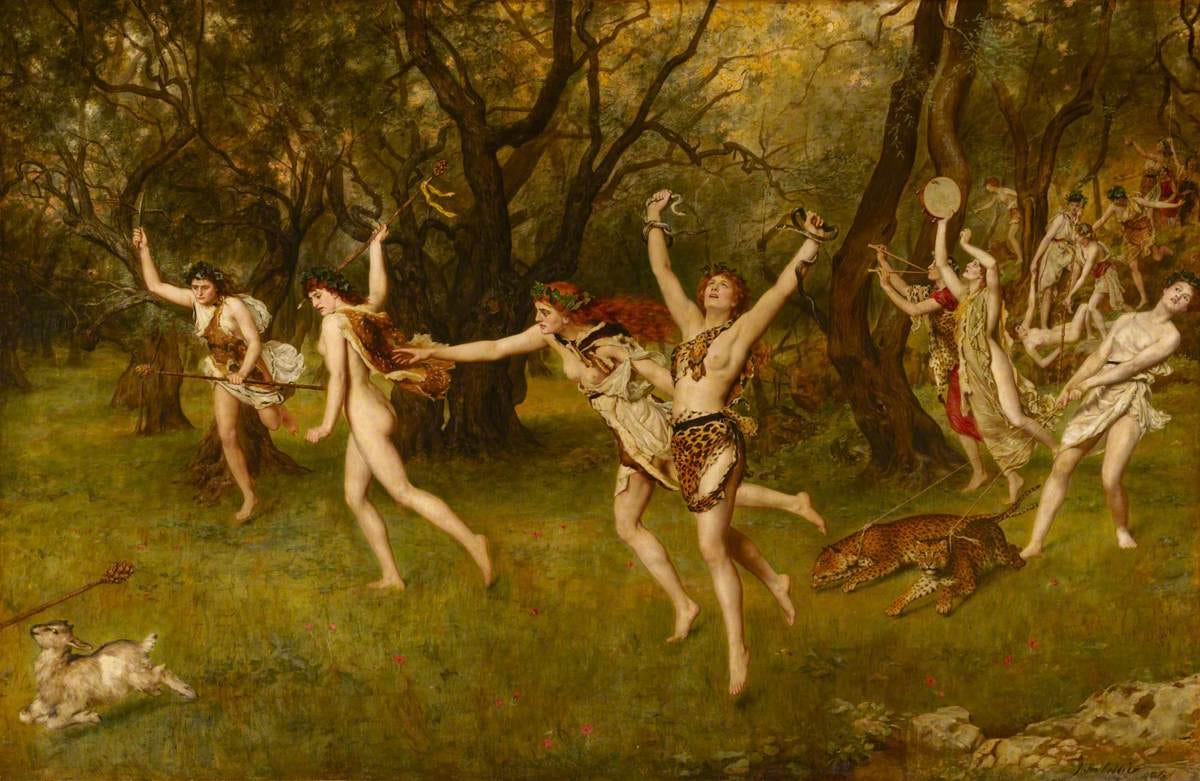
At some point in my dancing prayer, I felt the presence of a number of hands across my body. I opened my eyes (I like to dance with my eyes closed). There was a sort of swirling tangle of all women, mostly over 40, that I was slowly being absorbed by. They brought me down to the floor and we moved as a group in this trancey way. Then I came into the arms of a woman behind me and another lowered a finger onto the middle of my forehead. She moved the skin there ever-so-slightly, in a way that somehow made my whole body relax.
None of this quite captures the boon, however. The boon of Dionysus is not something material, but a state: ekstasis, translated as “ecstasy.” But in the Dionysian context, the word’s etymology does a better job: ekstasis -> “outside-oneself,” a state of transcendent consciousness.
Then the dance ended. One woman asked, “Who is he?” Another answered, “Obviously, one of us.” (I felt cool when they said this.)
Who were they? “Witches,” they said. (Of course.) They invited me to their next three gatherings.
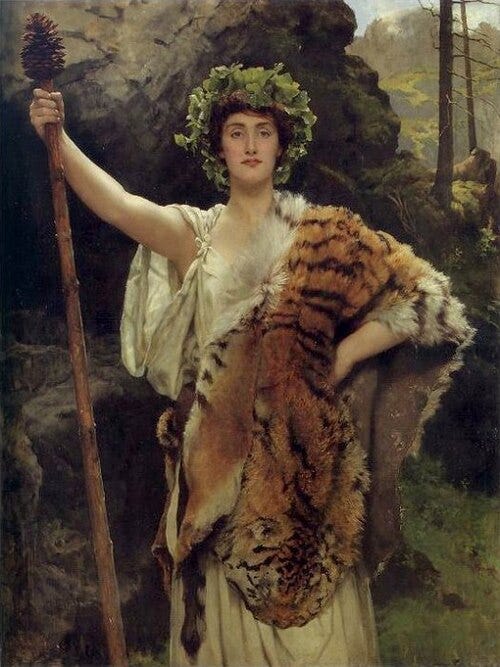
You might think this whole [dance prayer to Dionysus] ➔ [adoption by a group of mystical ladies] thing is a fluke. But actually, this is maybe the fourth or fifth time that a very similar sequence of events has happened to me. It’s just the first time I went through it with Dionysus explicitly in mind. (One worships one’s gods regardless of whether one is aware of it.)
You can try something similar! Figure out which gods you already have affinities with, and ask them what would please them. They might be traditional gods, like Dionysus, or they might be nontraditional ones, like [the spirit of scientific inquiry].
“What if I don’t believe in gods?”
Surprise! I don’t either. Or rather, the main view I hold is that gods are not “supernatural” but mental renderings of abstract patterns. The gods are agencies living inside of us.
“Then how do they award their boons?”
A couple of ways:
Perception: They can alter your perception, so that, e.g., what previously seemed to be an ordinary tree – the one you pass every day on your way to work – now suddenly seems to shine from within. A boon of enchanted perception.
Memetics: Gods can rapidly hop minds to influence the people around you (often simply through people mirroring your behavior). A boon of enchanted sociality.
“Wouldn’t believing this drive you crazy?”
Yes. I see beliefs like this driving people crazy. I think a good way to maintain sanity is to entertain all belief systems as not representing the world as it truly is. Instead, one can play with them as a practice of “view.” You try them on, and also try on contradictory belief systems, and ideally don’t get attached to any of them, including this one.
Have fun =)5
This entry was written after 5Rhythms, a dance practice that happens all over the world with bacchanalian energy. It’s become so popular in New York City, that hundreds attend almost every day of the week, and tickets sell out for many events ~immediately. 5Rhythms is quite related to ecstatic dance, an even more popular practice across the world that has questionable aesthetic but undeniable Dionysian energy. Meanwhile, members of my own community at Merlin’s Place regularly host sold-out raves.
The drive toward liberation cannot die; it is eternal. It might be that this drive has suffered a dip in America. However, it might also be that the future of Dionysus is already here – it’s just not evenly distributed. It doesn’t have to be so. Joy is unevenly distributed, and yet accessible at any time. It is there, in that open that is the background to weariness.
And you, couldn’t you use a break from the grind of the the workaday, the horror of the news cycle, the mass performative outrage? Maybe you hear his call beckoning you to bring your Bluetooth earphones into the woods, or into a park at night, a place where you can flail your limbs and be free. Bring wine, or bring water – one who is wonder-filled can get drunk on water. GK Chesterton wrote of fairy tales:
They make rivers run with wine only to make us remember, for one wild moment, that they run with water.6
Drink from the river and be drunk. Thaumatourgos, they called Dionysus, wonderworker. His maenad once struck the earth with her wand atop a mountain and wine poured forth like a fountain. Can you do the same? Can you become intoxicated by the world itself?
There is his kingdom.
For his kingdom, it is there,
In the dancing and the prayer,
In the music and the laughter,
In the vanishing of care,
And of all before and after;
In the Gods’ high banquet, when
Gleams the grape-blood, flashed to heaven;
Yea, and in the feasts of men
Comes his crownèd slumber; then
Pain is dead and hate forgiven!
Let pain die, and let hate be forgiven. Offer it up, laugh it off – drunk on your own liveliness: the ruminations, the petty grudges, the things they told you you were supposed to be; offer it up to the dancing and the prayer.7
Hail, to Bacchus. Hail, to your own current of life. Hail, to that which has already survived your deaths and rebirths, and which lives still today.
Now—that’s enough words for a god who prefers moving and shouting. So to end, here’s a silly little dance video called “Joy Transmission.” It ends in one of those Merlin’s Place raves that I mentioned. A token of worship:
Dionysus is also associated with other related things: fertile nature, the theatre, paradox, wonder-working, and life-death-rebirth (according to myth, he is either twice-born or thrice-born).
https://ifstudies.org/blog/the-sex-recession-the-share-of-americans-having-regular-sex-keeps-dropping

https://news.gallup.com/poll/693362/drinking-rate-new-low-alcohol-concerns-surge.aspx?utm_source=chatgpt.com
No, really, have fun. Euripides wrote, “Only on them that spurn / Joy, may his anger burn.”
The Ethics of Elfland by GK Chesterton
I realized after reading your series that I approached the same lens (recognizing and working with psychofauna) as an Apollonian Christian animist. I believe they are real and I want to understand them and explain them but I refuse to worship them. It’s nice how we seem to be very different. This is good for the field of psychofauna studies! (Dionysus has a cameo in my historical novel btw)